This week, I’m reflecting on two articles that made me pause and consider how we’re using technology.
What does it mean when we all want to get off social media? What happens when we order every sandwich over an app, and never interact with the person making it? Should AI really write our emails? Would we miss typos if they were gone forever?
What do “No-Phone Challenges” mean for the future of social media?
📡ON MY RADAR: After my 5-Week Phone Fight, I’m Never Going Back to the Way Things Were Before Learnings from 30 days with no social media, news, or games by Steve Pratt
Steve wanted to fight his way out of his phone addiction and the brain cloud it created for him, so he deleted social media apps, news, and games on his phone for a month. I’ve tried this kind of challenge, too, and had similarly transformative results.
But one thing Steve wrote made me pause:
I am going to give myself a full green light to post on social media, guilt-free. I am going to hold myself to a high bar and do my best to post content that is valuable to others and not humble-brags, ego-gratification, or clickbait.
On the other hand, scrolling through the various social feeds feels unhealthy and like an exceptionally poor use of my time. I like getting updates on what my friends are doing in their lives, but with the increasing algorithmic nature of the feeds, less and less of the posts are from people I actually know. And once you start scrolling, we all know it’s really, really hard to stop scrolling… by design.
Basically: He’s going to keep posting to social media, but not consume social media.
This isn’t a revolutionary idea; most people would like to spend less time beholden to social media, while still sharing their stuff and staying relevant. I’d include myself in that group.
But something has to give eventually. If more and more people want to create content but not consume it, who are we all creating it for? Who are the poor suckers who are going to be left scrolling for our stuff while we piously abstain?
If we all agree that social media is mostly a distraction and a time suck (and an endless ad machine), will we all move to sharing content somewhere else and give up on social media entirely? We’re certainly seeing this already. I get more news and analysis from email newsletters than from social media. And I’d love for old-school long-form blogging (RIP Google Reader) to come back.
For me, writing online is part of my thought leadership practice. I do it more for myself and to develop my thinking and my body of work than I do for likes and shares. Most of my clients are doing the same, with the goal of sharing their ideas with a small circle, on stages, in books, or in top business publications…not just on LinkedIn. So, does social media even matter anymore, especially if we all hate it?
❓What do you think? Are you spending less time on social media? If you’re just posting, who are you posting it for? And where do you think social media is going in the future?
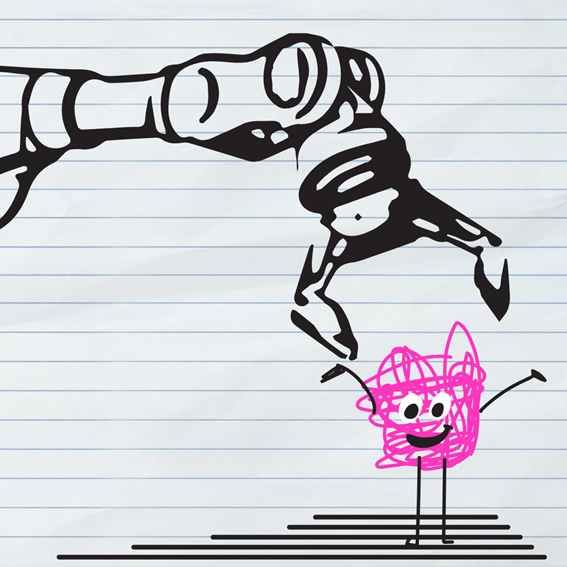
What do we lose when we give technology the dirty work?
📡ON MY RADAR: what will we let the computers do us out of? on AI and what happens when we choose artificial intelligence at the expense of human creativity by Emily Ash Powell
Emily opens with an A+ story from Kurt Vonnegut: he needed an envelope, and instead of ordering a box of them on Amazon, he jumped at the chance to get up and go out into the world to buy one…and pet a dog, talk to a human, see the sky, etc.
Emily faces the same paradox every day when she gets hungry for lunch. She could go out to the deli down the street for a bagel and interact with the world…or she could stay chained to her laptop and keep answering emails, and get the bagel delivered in a few clicks (or, meh, maybe she’s not hungry at all).
These stories frame a question: What do we lose when we outsource our tasks to technology?
I understand that there are certain corners of our lives in which AI has the power to radically transform things for the better.
Because as it goes, convenience isn’t the thing that sets the human heart on fire. Maybe somewhere along the way, the things that stood in our way actually helped us to think better, do better and be better. Maybe tech solutions aren’t actually designed with human’s best interests at heart?
My husband and I have a running argument over ordering Pub Subs (Florida’s favorite sandwich). We save a ton of time waiting in long lines if we order the subs on the app. But he likes to tell the deli worker exactly how he wants his sandwich. He likes the interaction.
This isn’t really about sandwiches. It’s about how we save space in our days for human interaction, for walking into the grocery store, for prioritizing messy/inefficient/human time over the streamlined alternative.
And the same goes for other tasks — writing emails, to use an example from Emily’s piece.
I loved this anecdote:
Let me tell you about the time in Adland when I emailed a creative director on behalf of myself and my creative partner, Elsie. I didn’t notice that my signoff of ‘Em’ had been autocorrected to ‘Emu’. The creative director replied with, ‘Hi Emu’, and so I earned a new nickname. That was seven years ago. Today, Elsie’s two year old son calls me Aunty Emu.
It’s mistakes like this that make us human. It’s the dancing around (whether intentional or not) that adds colour to every scene we’re in. What makes people gorgeous and interesting is not what we can always get right, but what we can sometimes get wrong.
For me, it’s important to think about the way I use technology as a constantly evolving experiment. If I try using AI to help me with a task this week, I don’t have to keep doing it that way next week. I can play around and look for what works, and I can always change my mind/delete the app later.
❓What do you think? Do you find yourself assigning more tasks to tech? Are you reclaiming some of those tasks?