Think about a big-name thought leader you follow and trust.
Who are you picturing?
I’d bet you’re thinking of just ONE person. One person’s name. One profile picture on LinkedIn. A single face on a book jacket. A splashy headshot on an event agenda.
But in my career collaborating with thought leaders, I’ve learned that the best ideas generally aren’t developed alone, but by working and thinking with others.
So often, that “one” person you see sharing ideas has been shaped by years of collaboration. They’ve developed their ideas/frameworks/examples by closely collaborating with someone else — often with a whole team of people.
Collaboration shapes much of our thinking and writing about work, and I’ve seen that collaboration makes our thinking stronger. Let’s talk about why.
Collaborative thinking: Put your heads together
I often work with big firms that hire people for their strong thinking skills. These clients have taught me the power of collaborative thinking.
When your organization’s product is your thinking, you don’t hide your best ideas or hoard them for yourself. I especially see this at management consulting firms. The more heads they can put together, the better. Their goal is stronger, more complete thinking for their clients, so they’re trained to collaborate constantly.
That makes developing thought leadership for management consulting firms a naturally collaboration-heavy process. One person might have experience testing a framework with retail clients. But their colleague has used that same framework with industrial clients, with slightly different results. And someone else at their firm has tried out a similar approach on a different continent, and can speak to the cultural nuances to consider. That’s a jackpot for me as a writer. I want all the inputs to make sure the final idea is as strong and nuanced as possible.
And yes, I have griped before about “creativity by committee” — that sinking feeling when 14 people are editing a draft simultaneously, sometimes giving opposite feedback — but I’m making an opposite argument now. I’ve seen that collaborative thinking makes ideas stronger and more solidly pressure-tested.
Here’s a current project that’s teaching me about the magic of collaboration:
I’m working on a book proposal with two co-authors. They have a shared interest in a niche topic. But how they got there? Wildly different. One has spent their career as an academic researcher and startup founder; the other has a background in engineering at giant tech companies. While their work is in an overlapping field, they know different people, have lived in different parts of the world, have different styles, and go down different rabbit holes. I’ve loved the experience of learning two different approaches and ways of thinking, and looking for ways to weave their ideas together.
When we’re in a room together hashing out ideas and telling stories, I watch them play off each other like they’re in an improv group. They respond to each other with the classic “Yes, and…” but also argue (“But…”) and add to each other’s thinking (“Also…”). (I’ve shared before that “and, but, and also” are music to my ears when I’m trying to get ideas flowing.)
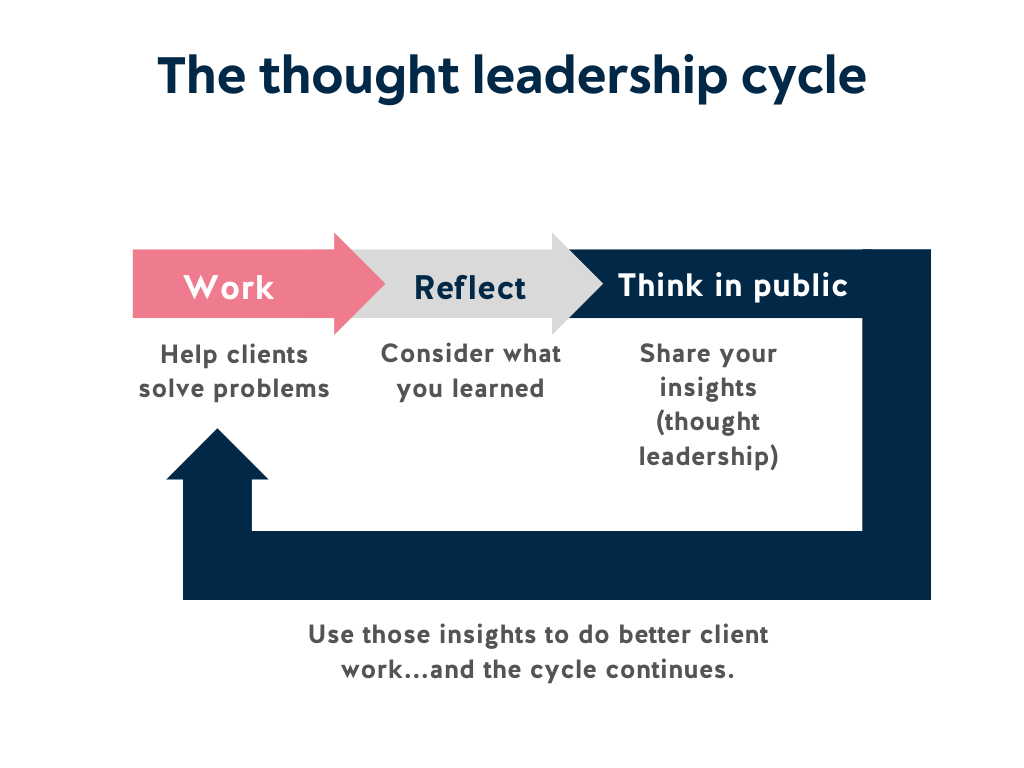
As a result of their collaborative thinking on this book proposal, they aren’t just making their ideas for the book stronger. They’re making their core work itself stronger — reflecting on what they’re seeing, what they’ve learned, and where they think their field is going next. That kind of collaborative idea-bouncing (the middle “REFLECT” part of the cycle below) makes everyone better, immediately.
Collaborative writing: Find the right words
At Gathering of the Ghosts in November, I was reminded that just as I’ve gotten comfortable with the term “ghostwriter,” many ghosts are branding themselves as “collaborators” or “collaborative writers.” Calling ourselves collaborators is apt.
Ghostwriting is incredibly collaborative, with a heavy dose of push-and-pull. I do my own “and, but, and also,” pushing on my clients to dig deeper or share more, or even, sometimes, to reconsider something. Even if I’m not inserting my ideas or my words, my influence (my judgment, my curiosity, my relationship to the author) shapes every piece I’ve touched.
So if you can’t quite untangle how you’re thinking about your work, or you can’t find the right words, look for potential collaborators around you. Maybe it’s a colleague who can help you hash it out, or someone in your organization whose thinking you admire. Maybe it’s a ghostwriter who will push you to answer questions in new ways.
Open your mind to the benefits of collaborative thinking and writing, and see where it takes you.