
For the past few months, I’ve been working on a book project. It’s a long-term, long-form project that requires a lot of thinking out loud, ugly first drafts, re-thinking, and refining. I find myself asking the authors the same question, on different days, and hunting for new answers.
A lesson I learn over and over: In writing, there is no shortcut or AI-powered magic button. Instead, you have to work through your ideas to understand and then refine them. In other words: the process is the point.
Explaining our work takes practice
You know what’s wild? How little practice most of us have explaining what we do.
I’m terrible at it. If a stranger asks me what I do, I either give an overly polished answer that sounds like I’m a walking LinkedIn profile… or I stumble and only manage to eke out a few words, or maybe sneeze. I’ll walk away, stunned, and wonder: What’s wrong with me?
The same thing is true when I interview someone about their work.
There are several symptoms at play here. First, many people want to sound like their Most Professional Self and give All the Right Answers and sound Super Smart and Confident and Correct and Use Serious Technical Jargon (zzzz).
But even when people are feeling relaxed and capable, they battle another pervasive challenge: We just don’t have much practice explianing the nuances of our work to people outside our narrow world.
Ready for my marathon metaphor?
If someone in your field asks what you do, you could probably easily chat about your latest project. You have a shared common language. You don’t have to inflate or deflect. You can be real. You’re starting many laps in, moving in sync, matching each other’s pace.
But if someone who’s completely foreign to your world asks what you do, it’s like someone on the starting line asking a marathoner on mile 20 how to take the first step. “What’s it like to run?” they ask.
That novice standing on the starting line asking the pro marathoner about running? That’s me, every day, doing my job of interviewing experts about their work. [I’m having a moment of extreme empathy for my poor clients, who sigh, pause their stride, and circle back to jog alongside me in my brand-new sneakers.]
The “right” answer
Here’s how that plays out.
I’ll ask a simple question: “What does that mean?”
I could be asking therm to define a technical term they casually skipped past, or to tell me more about a certain scenario.
I want them to circle back, jog slower, and think through what their words really mean. I’m trying to slow them down, help them simmer a little in their ideas, and break it down for the eventual reader.
But often, experts hear my questions and assume there’s a right answer.
But here’s the thing: I’m never looking for the Right Answer to a question about how something works. I’m most definitely not looking for the amalgamation of Right Answers that AI spins up.
Instead of the right answer, I’m looking to understand an author’s unique way of thinking. Their understanding based on their specific career experiences. I want to know how they learned it.
I want them to talk me through the process of how that technical concept has played out in their work.
Which is all sooooo much juicier than a simple textbook definition.
But when someone is a certified expert on their subject matter, they’re used to having the Right Answer. So when I ask them new questions, or ask them to explain a concept to me in a way they haven’t before, or ask them a question at 101 level when they’re spinning up graduate-level thinking, they don’t have the words at first — and that makes them feel like they’re doing something wrong. Quick, find what she’s looking for so she’ll stop asking me questions!
Think, think again, re-think
In the end, the only way to build a body of work about your work? Think, think again, then come back and react to that original thinking, re-working it with a new eye.
On my current book project, we’re only about 40% of the way through our first pass at the book’s manuscript. We’re still building v1. But already, the authors (who, like every busy expert I’ve worked with, find this process to be new, uncomfortable, and at times grueling) have seen the magic of the process.
The core ideas they presented on day 1, back in the winter? After thinking and thinking again, they disagree with their former selves. They’ve learned a new way to define their big ideas. They are seeing their argument in a new light thanks to the gift of time and repeated reflection. They’ve worked on client projects that have illuminated a new angle, or disproven their original take.
This is the process at work! It’s thrilling to see people learn about their own ideas through this constant cycle of reflection.
This is how I visualize “the process,” which I called the “thought leadership cycle” when I made this graphic in 2022:
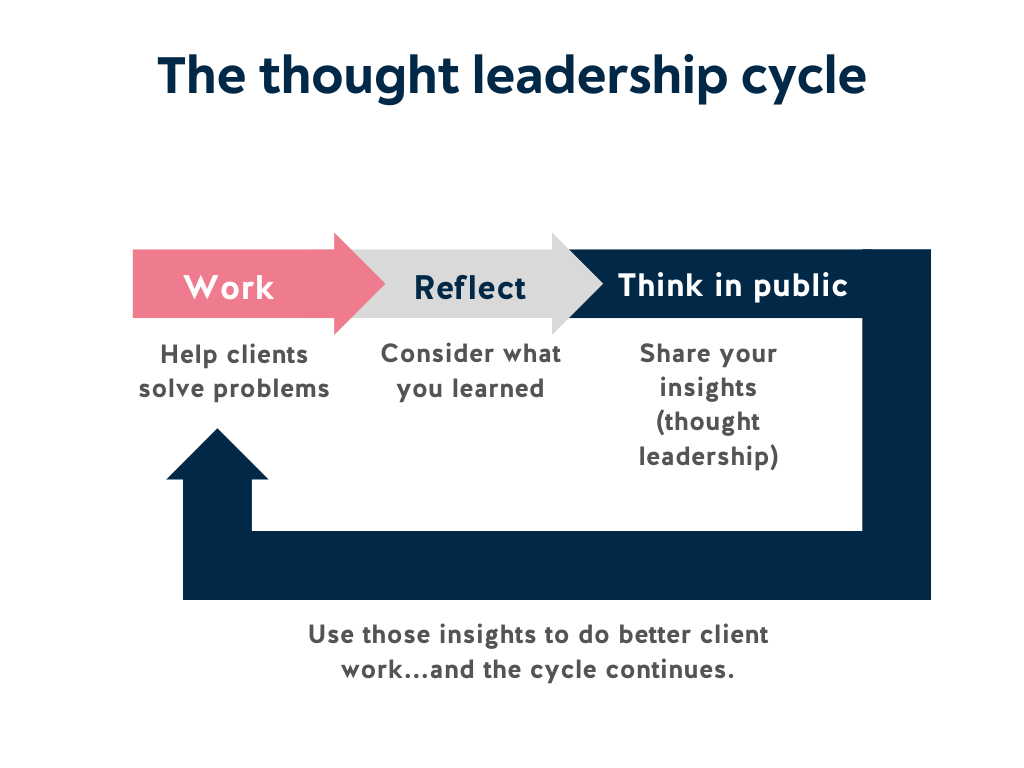
The only way out (to the end of a manuscript) is through (thinking, reflecting, practicing, and in my clients’ case, answering my questions and looping back with me over and over until we — aha! — get it right).