It’s wild how quickly you lose a well-worn skill when you just…stop using it.
Handwriting, for example. This week I went to a new doctor, where I was handed a clipboard and pen to fill out what felt like hundreds of similar forms. By the fourth form I’d filled, signed, and dated, I could barely scrawl a legible “5/27/26” without concentrating on moving my cramped hand slowly.
I’m a *writer* by trade, and *writing* some basic information on a few doctor’s office forms was physically difficult for me.
I was the kid who would experiment with different flourishes and handwritings depending on the month. I filled notebooks with handwritten stories in different inks and styles.
But I never write by hand anymore. My work all happens on a laptop, and most to-do lists, grocery lists, notes to self, etc. are typed on my phone.
Because I don’t use my hands to write anymore, I’ve essentially lost the ability to communicate via handwriting. I can’t even reliably write a legible date next to a signature line.
In that doctor’s office, I realized a parallel to what I’m seeing slowly seep into my work life. People (even very smart! very accomplished! people) seem to have a fading ability to communicate their ideas — to talk things through the long, hard way (no LLMs allowed). Just like I’ve lost the ability to communicate by handwriting, I see how easily we could all lose the ability to communicate our ideas without the mediating hand of AI.
———
What happens when we stop doing our thinking for ourselves? I already see this question becoming relevant among the (again, smart and accomplished) people I work with.
Wait…are you reading something?
I was sitting in a room with a very smart person who was paying me to help him communicate his big ideas.
I’d been interviewing him for a couple of hours, circling around his core experience and what he’d learned about his field.
He told me a story, and I asked a clarifying question.
Before he answered, he looked down at his lap for a minute, then started talking again. But he was talking a little too smoothly…
I shifted in my chair to see the screen resting just below the table. “Wait…” I stopped him. “Are you reading something?”
He was. He was reading AI-generated answers to a question I asked about THE IDEAS INSIDE HIS HEAD.
No easy answers
I tell this story not to shame anyone, but to highlight what’s happening all around us right now. It’s getting tantalizingly easy to outsource our thinking to robots. We all have big shiny buttons floating just at the edge of our vision: CLICK ME FOR THE ANSWERS!
It’s so easy to just click. To just accept the long, tight paragraphs of confident explanations that Claude and Gemini and ChatGPT spin back at us.
When we let robots shape our thinking, we think we’re each following our own unique and personalized rabbit holes. But there’s new research about what happens when we all surrender to the pull of easy AI-generated answers. And it turns out, we all fall down the same rabbit holes.
Reporting from an article about (I love this term) “The Great Flattening”:
A research team led by Liwei Jiang at the University of Washington, Carnegie Mellon, and the Allen Institute for AI published what became the Best Paper at NeurIPS 2025. They gave their finding a name: the “Artificial Hivemind.”
The team tested over 70 large language models using a dataset of 26,000 real-world, open-ended queries, the kind of things people actually type into ChatGPT, Claude, Gemini, and other tools every day.
When they asked 25 different models to write a metaphor about time, each generating 50 responses, the outputs didn’t spread across the conceptual space the way human answers would. They collapsed into two clusters. One group wrote variations of “time is a river.” The other wrote variations of “time is a weaver.” Different architectures, different companies, different continents, two ideas.
…
The infrastructure itself is homogeneous.
…
The researchers aren’t saying AI makes bad content. They’re saying AI narrows the range of ideas that circulate. Over time, as people read and internalize AI-generated text, the boundaries of what feels normal or expected tighten and the conceptual space shrinks.
Did you catch that? AI “narrows the range of ideas that circulate.” I’ve spent most of my career helping people reflect on their work, mining for new ideas and unique perspectives and resonant stories that add to the conversation in their space.
If we short-circuit that work by sitting back and letting AI take the wheel, we lose the story, the personality, and the insights themselves. What a waste.
If we want new ideas, we need to create idea labs
I don’t want to hear what robots think. I want to hear what my human clients think…what human authors think, what human analysts think, and how human leaders would respond to a given situation based on their experience and wisdom.
So, how can we all protect our ability to think deeply for ourselves? How can we keep adding new ideas to the conversation? How can we retain our thinking and reflecting and intellectual sparring skills so they don’t go by the wayside like my handwriting has?
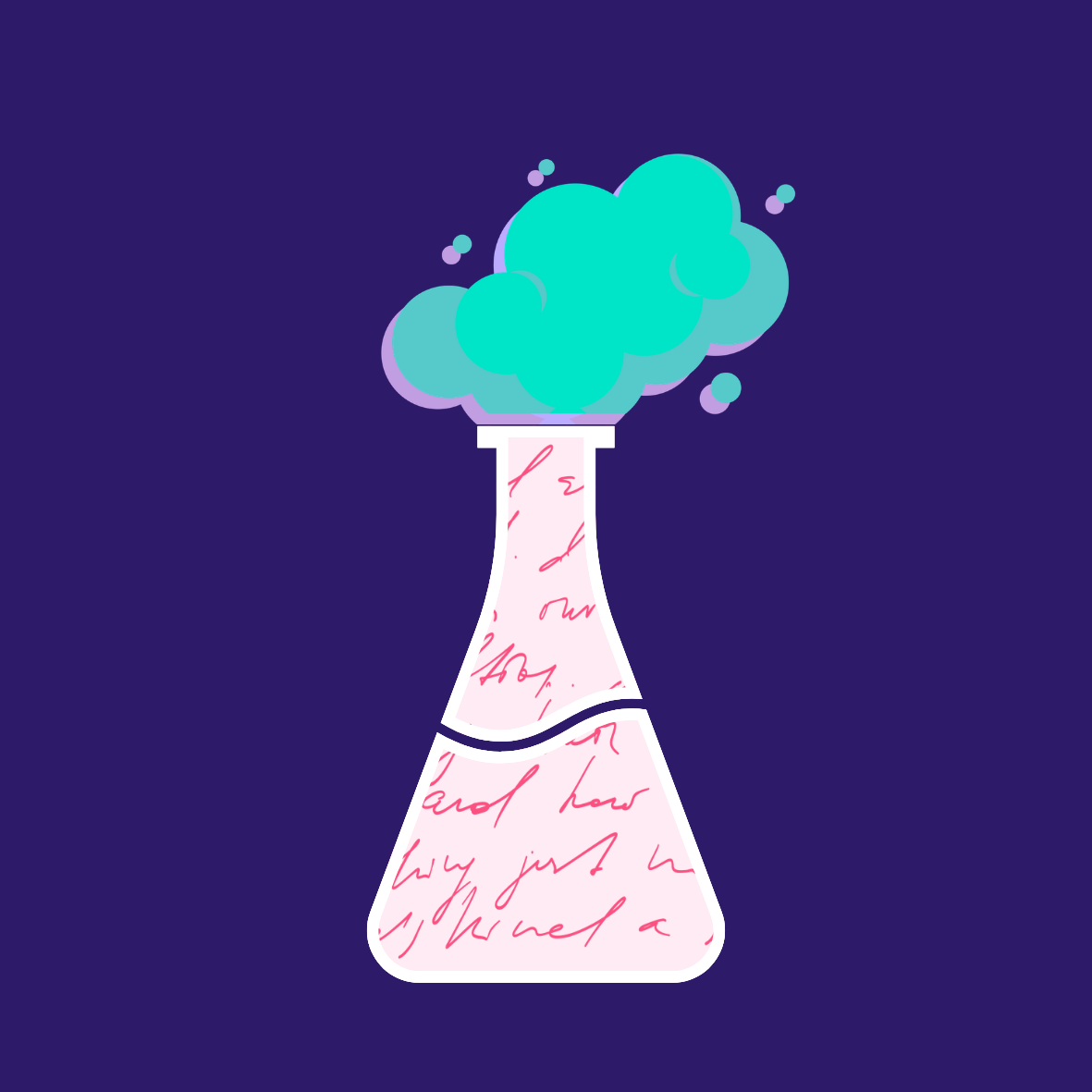
The answer is actually pretty simple: we all need to build our own idea lab. A hot, messy little laboratory where the bots aren’t allowed, and you can stir up new potions, throw new ideas against the wall, play around, reflect, think, consider, argue, try something different, look for patterns, and generally do your own critical thinking without nudges from AI.
This newsletter is my long-running idea lab. I write it for myself — to give myself a recurring deadline that makes me stop, reflect on my work, and package it in a way that other people can understand.
Your idea lab could be:
- Regularly scheduled conversations to just think about what’s happening in your work. You could talk to a colleague or a friend who does similar work or a thought partner like me. No formal output required. Just talking it out. Noticing what comes up and what patterns appear over time. My work is built on these recurring conversations. I ask questions like: What’s changing in your world? What concerns are you hearing from your clients right now? What has surprised you lately? What do you predict is coming next? And I’m sorry to be gloomy, but in the past few years I’ve seen a marked decline in people’s abilities to have these conversations. Maybe it’s because AI has pushed us to over-optimize every hour (Why would we just shoot the breeze without a firm predetermined outcome?). Or maybe it’s because we’re losing tone in that muscle — the ability to talk through our thoughts with a sparring partner or sounding board, without pulling in AI to finish our sentences for us.
- A handwritten list every Friday afternoon. You could accomplish two things at once: keep your handwriting muscles strong, and create time to reflect on what’s happening in your work. Your list could be titled What I Noticed This Week, or Questions I’m Trying to Answer, or Things to Figure Out, or even Five Words to Describe My Work This Week. Anything to get you used to reflecting on what’s happening TO YOU without the assistance of an AI agent scraping the themes from your call transcripts/email inbox/calendar FOR YOU.
- A recurring deadline. This newsletter is my recurring deadline, but you don’t have to start a newsletter to hold yourself accountable. You could set a goal of writing a LinkedIn post about your work once a week. You could write a Slack message to your team summarizing themes you’re seeing in your projects at the end of every month (you might already have AI doing this for you, but wouldn’t it be fun to see what your human brain notices??). Go wild and write a haiku at the close of every client engagement. The format doesn’t matter as much as the deadline itself, and the reflection that it forces. You can read my ode to my own self-imposed deadline here: The Incredible, Compounding Effect of (Terrible, Annoying) Deadlines
We need idea labs to keep the new ideas flowing. To capture our unique moment in time. To remember (or even see for the first time) what we’re learning. To make our work matter.
I don’t want to hear smart people’s perspectives mediated by the typos they slap into an LLM. I want to see what comes out of their own messy, off-kilter idea labs. Less copy-and-paste. More mad scientist.
The messy, imperfect thinking is the whole point. It’s why we do “knowledge work.” Without the thinking, the work doesn’t mean much.
Deep thinking, people! Let’s hang onto it, even when it’s hard.