
I’m in the slow, messy middle of ghostwriting a manuscript. The part of the process where every step forward comes with two steps back. Working on long, layered projects is hard work.
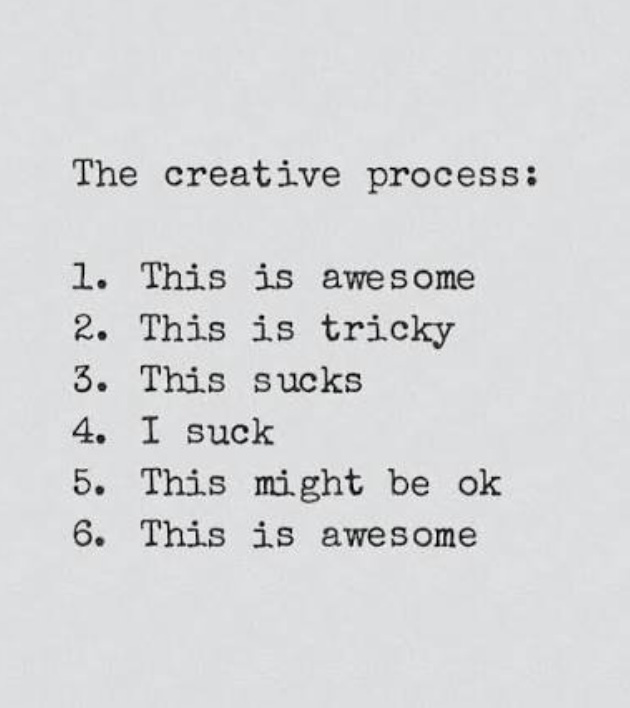
I recently saw this 6-step summary of the creative process and it made me feel seen:
I walk through those 6 stages every week…sometimes in the span of just one day.
This is awesome: New project! Great ideas! So much potential!
This is tricky: But when you start digging into the details, just under the surface you hit a rock. Hmm. Maybe this is going to be harder than I thought. This is actually kind of…complicated.
This sucks: Forget what I said. This is a terrible idea. No one could ever do this well.
I suck: Actually, I’m sure other, smarter, more experienced people could do this. But not me. I’m not smart enough for this! I’m a fraud.
This might be ok: After tunneling my way out slowly, I have a rough draft. It’s not perfect, but *maybe* it’s okay?
This is awesome: I’m done! I did it! And people like it. I can do anything…
(and repeat…)
In my experience, the creative process follows this arc no matter what kind of project I’m working on. The difference is what “this is tricky” means.
As a B2B writer, the whole job is diving into “this is tricky” themes. Explaining complicated healthcare terminology. Dissecting manufacturing processes. Clarifying obscure financial concepts. “This is tricky” is the reason B2B writers have work — if it wasn’t tricky, anyone could do it.
You know what else is tricky? Pulling ideas out of someone else’s head. As a ghostwriter, I can’t just go research a subject on my own. I need to understand how one specific person thinks about that subject — how they’ve learned about it, what they have to say about it. And, unfortunately, people are tricky. It can take me months to get to know someone well enough to be able to tug ideas out of them and translate them into words in a way they recognize as their own voice.
But most writing has its tricky moments. For several years, I’ve been working on a novel — sometimes in earnest, sometimes casually. You’d think fiction would be easier since it’s, you know, made up. But of course it’s hard! I’m drawn to reading and writing fiction that makes sense of big feelings and complicated interpersonal situations. Elegantly telling stories about fraught relationships and all the feelings that bubble under the surface? That’s tricky.
Some days I do wish my work wasn’t so tricky. But today, I’m renewing my gratitude. I’m grateful that I get to tackle tricky work. I’m grateful for the challenge of solving unclear puzzles and turning tough topics into easier paths for readers. When I’m in the messy middle and the work is slow and difficult, I’m trying to remember that the process is the point. The struggle that means I’m grappling with complex ideas. I’m pushing back on obvious answers, looking for new ways to make sense of complicated concepts, and working hard for the eventual reader.
Tricky work is a challenge, sure. But it’s a thrill, too.